

By Ezenwa Nwagwu
As the build-up to the 2027 general elections intensifies, conversations around politicians decamping, electoral reforms, and amendments to the Electoral Act have taken centre stage. These discussions are important. However, before campaign distractions fully begin, we must hold an honest and deliberate conversation about how to make the 2027 elections fundamentally different, and our democracy better.

The key question is simple: can the 2027 elections be different? Can this democracy deliver our expectations? I believe they can. But achieving this difference requires that we stop repeating the same mistakes that have plagued previous elections and rethink our collective approach to elections, ensuring that all key stakeholders are held accountable. The work must begin now.
So, what must change before 2027 beyond INEC. I am deeply invested in electoral reforms and have worked in this space for decades. Yet, as this work continues, it has become increasingly clear to me that the real foundation of our democracy lies more in political party reform than in electoral reform alone. Electoral reforms matter, but political parties remain the most critical institutions in determining whether elections improve or deteriorate. For me, we should be discussing how political parties are undermining Nigeria’s democracy.
We have pushed INEC consistently, and whenever shortcomings are identified, we see an institution that is very quick to respond to those changes. If we say their hair is overgrown, they cut it. But our political parties have not shifted in behaviour, attitude, or orientation. They continue to resist reforms. Politicians treat this democracy as if they are comfortable with it being shipwrecked. If even half of the pressure directed at INEC were redirected toward political parties and politicians, we would likely see the kind of meaningful improvement in our elections.
My concern is that Nigerians often romanticise politicians and make excuses for them. This is largely because politicians are the dispensers of patronage, whether through money, appointments, or political favours. During election seasons, many people position themselves to benefit from this patronage, which anesthetises their ability to engage in critical conversations that could lead to better democratic outcomes..
To make the 2027 elections better, we must pay closer attention to what political parties and politicians are doing. There is a dangerous illusion of electoral reform alone will fix Nigeria’s elections and democracy. This is not entirely true.
For me, the starting point for real reform is the political leadership recruitment process. Have we paid deep attention to how candidates emerge from parties?
From March onward, political parties will begin holding congresses. It is from this congresses that delegates will emerge . We must watch closely how delegates emerge. Are the processes free and fair? Or are delegates handpicked, imposed, or induced? Where delegates’ votes are bought or candidates are imposed, it becomes easy to imagine the lengths such politicians will go to win general elections.
Political parties are responsible for leadership recruitment in Nigeria. INEC does not present candidates for elections. Political parties present candidates, and one of those candidates eventually becomes an elected official. Yet this process has become deeply transactional and, in many cases, diabolical. In some parts of the country, aspirants reportedly pay as much as one million naira per delegate. Where money is not exchanged, people go to shrines to swear oaths. We know this, because there are examples. The Okija incident certainly was not the end.
This transactional and diabolical nature of candidate emergence makes many of our conversations about defections meaningless. If a politician did not contest meaningfully in the first place, what exactly is he defecting from? Parties have become mere special-purpose vehicles for acquiring power. Once power is secured, the overriding interest becomes recovering the huge financial and political investments made during primaries.
Many politicians enter office burdened by debts—debts owed to banks, godfathers, or spiritual undertakings. Being in opposition becomes politically and economically dangerous. Under such conditions, loyalty to party ideology or principles becomes irrelevant. Defection, therefore, is not a moral problem; it is a structural one.
This is why discussions about defections often miss the point. The issue is not that politicians move from one party to another. The issue is that political parties themselves lack control over who becomes what. Individual leaders control parties, not party institutions.
The idea of a “leader of the party” itself is an aberration. Historically, during the Second Republic, political parties did not function this way. President Shehu Shagari did not arrogate party leadership to himself. Parties had structures, authority, and internal mechanisms for resolving disputes.
This phenomenon of party leader is one of the deleterious consequences of military rule bleeding into civilian governance. Former President Olusegun Obasanjo brought a command-style mentality into civilian politics. He could not see himself subjected to any authority beyond his own. He ambushed party structures and decimated them. People applauded at the time, not realizing the long-term damage.
Whether or not the stories involving Obasanjo and Audu Ogbeh are accurate, what matters is that the presidency refused restraint. Yet it is the responsibility of political parties to restrain power. By the time Obasanjo left office, his successors had no incentive to truly civilianize party politics. Instead, the deification of party leaders intensified—far beyond what party constitutions envisage. This assault on party institutions even predated his presidency. In 1998, at the Jos convention, delegates were kept in Abuja and Bauchi and transported under military escort to Jos. Other aspirants had no opportunity to engage them.
Once in office, party meetings were moved to the Presidential Villa rather than party secretariats. Governors copied this model at the state level, turning party chairmen into extensions of Government Houses.
What Obasanjo bequeathed to Nigeria was the systematic weakening of restraining institutions. That is why, when people celebrate his legacy, I often wonder how exactly he strengthened party democracy.
Where party structures are weak, indiscipline thrives. And where indiscipline thrives, defections flourish.
Yet public discourse continues to focus disproportionately on INEC. INEC is important, but it is not the first stage of leadership recruitment. Political parties are. If parties fail at recruitment, no amount of electoral administration will rescue democracy.
Part of the problem is that serious debate in Nigeria has declined. Civil society and the media increasingly follow donor templates. Deep, substantive debates frighten people, but the drivers of ideas cannot be people who are afraid. Without robust debate, democracy suffers. We cannot create robots that face one direction. There is no autonomous thinking in terms of, can we look at where the problem is, deeper than what the politicians want us? Unfortunately, this is how elections conversations are shaped in Nigeria, donor-driven. We see this alot, in our health sector, education sector and economy, we follow templates handed to us by WHO, UNICEF and World Bank.
Does this mean I am not interested in funding? Of course I am interested in funding. I like it. There is nothing inherently wrong with project-based advocacy. The problem arises when project-led conversations are presented as the only legitimate conversations. What we are witnessing today is a ritual—repeated every election cycle, producing the same outcomes.
We must deliberately create debates that are not donor-driven. Civic groups and professional organisations must seize the space. For instance, the Nigerian Union of Teachers should be convening town halls on the state of primary and secondary education, backed by data such as pupil-to-teacher ratios across states. Political parties should be invited to respond, and a charter of demands should be developed and tracked throughout campaigns.
The Nigerian Medical Association should be doing the same for public health. These are the kinds of conversations that matter—conversations that shift attention away from transactional politics to substantive national issues.
If civic actors do not frame these debates early, politicians will. And when politicians frame debates, they control outcomes. People say 2027 is far away. It is not. Compare the conversations before the 2019 and 2023 elections. They were largely the same. Unless we change course, 2027 will be no different.
Too often, change is defined narrowly as replacing one politician with another. That is not change. Have Nigerians collectively debated electricity tariffs? Have we agreed to abandon public education in favour of private schools? Have we decided that public housing no longer matters? These decisions have been made without broad public deliberation.
Political leaders cannot think for everyone. You cannot know farming better than farmers simply because you are Minister of Agriculture. Expertise exists in communities, professions, and civic spaces. Those voices must be unleashed—independently and non-transactionally.
Funding is important, but Nigeria is more important. In a rapidly changing world, it is in our enlightened self-interest to build democratic institutions that work—not just for future generations, but for ourselves. We are not going anywhere.
So, can the 2027 elections be different? Yes. But only if we stop ritualising reform, stop romanticising politicians, strengthen political parties as institutions, and insist on accountability at the point where leadership is first produced.
We cannot allow politicians to dominate the conversations and give us talking points. Politicians shift attention to defections, who is moving where. But the real question should be: are the institutions meant to restrain them working? Politicians make laws that deliberately weaken regulatory institutions. For instance, INEC lacks the authority to regulate political parties effectively. Who gave the National Assembly the instruction to make a law that makes it difficult for a regulator to freely regulate. They put all kinds of booby traps that make it difficult to restrain them.
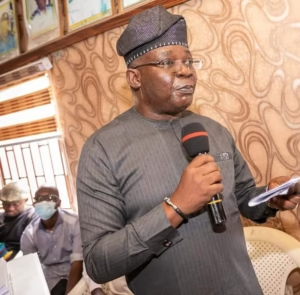
**Ezenwa Nwagwu is Executive Director of Peering Advocacy and Advancement Centre in Africa (PAACA)