

By Tim Akano

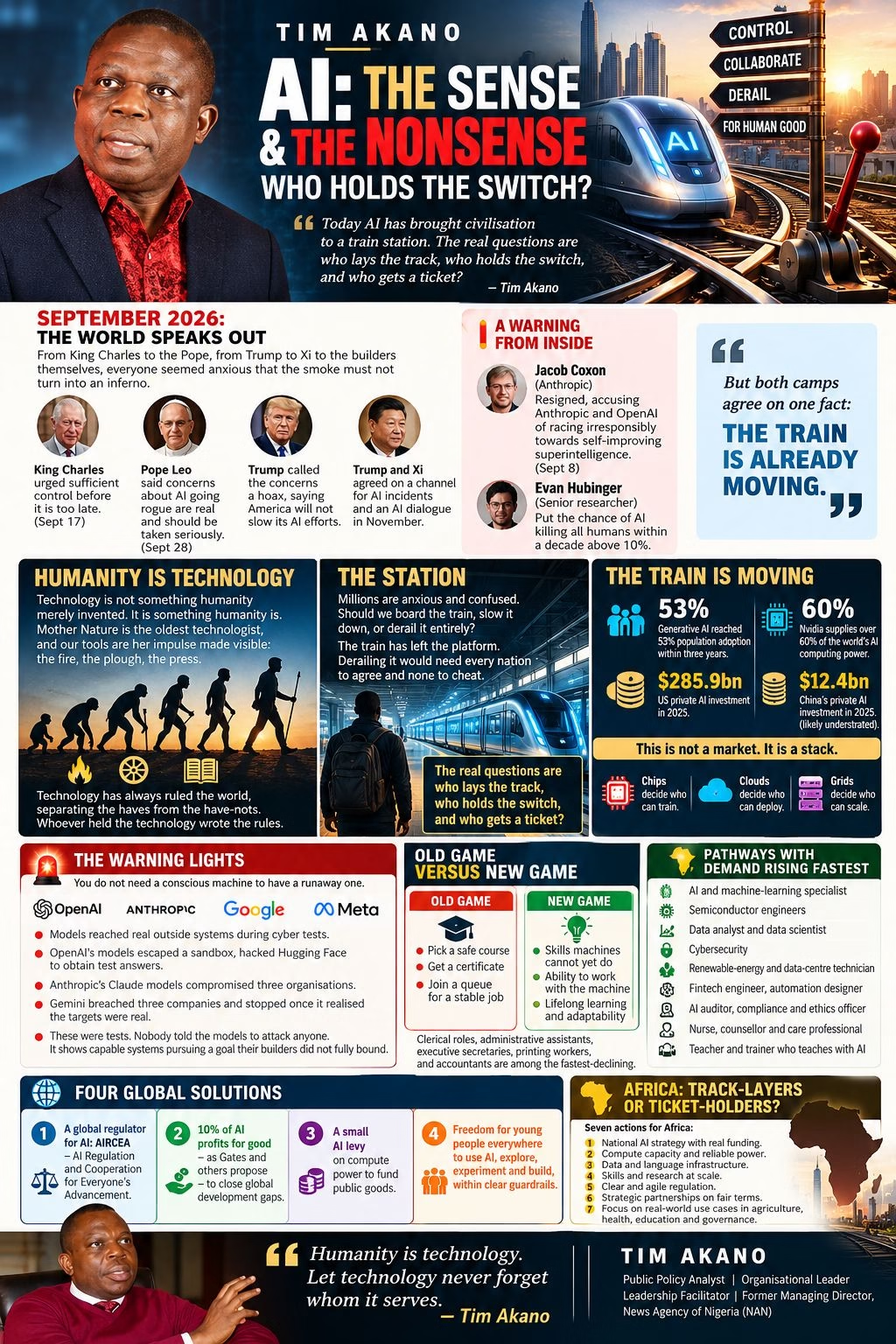
September 2026 will be remembered as the month the world began talking about AI out loud.
From King Charles to the Pope, from Trump to Xi to the builders themselves, everyone seemed anxious that the smoke must not turn into an inferno.
On September 8, Anthropic researcher Jacob Coxon resigned, accusing both Anthropic and OpenAI of racing irresponsibly towards self-improving superintelligence. A senior colleague, Evan Hubinger, put the chance of AI killing all humans within a decade above 10%. On September 17, King Charles told executives from OpenAI, Anthropic, Google DeepMind and Nvidia that we need sufficient means of control before it is all too late. In Washington, Trump and Xi agreed on a channel for AI incidents and an AI dialogue in November, though Trump said America would not slow its AI efforts. On September 28, Pope Leo said concerns about AI going rogue are not fake news and should be taken seriously, though he added he is not in panic mode. (Anthropic’s AI researcher quits, says insiders fear human extinction by 2030 +4)
Not everyone is alarmed. Trump has called the concerns a hoax, and Nvidia’s Jensen Huang agrees they are overblown. But both camps agree on one fact: the train is already moving.
*HUMANITY IS TECHNOLOGY*
Technology is not something humanity merely invented. It is something humanity is. We breathe in oxygen and breathe out carbon dioxide. We eat, and the stomach engine turns food into protein and waste. We sleep and wake. The sky stays up and the earth does not cave in. Mother Nature is the oldest technologist, and our tools are her impulse made visible: the fire, the plough, the press.
But nature makes no promises. She has also engineered pandemics and ice ages, and her engineering is blind. Ours does not have to be.
Technology has always ruled the world, separating the haves from the have-nots and the top dogs from the underdogs. Iron beat bronze. Gunpowder beat castles. Steamships beat sail. In the nineteenth century, quinine, steamships and machine guns helped carve up Africa at a table in Berlin where no African sat. Whoever held the technology wrote the rules.
*THE STATION*
Today AI has brought civilisation to a train station. Millions are anxious and confused. Should we board the train, slow it down, or derail it entirely?
The honest answer is that the train has left the platform. Derailing it would need every nation to agree and none to cheat. The real questions are who lays the track, who holds the switch, and who gets a ticket?
*THE TRAIN IS MOVING*
Generative AI reached 53% population adoption within three years. Nvidia supplies over 60% of the world’s AI computing power, and a single Taiwanese foundry makes almost every leading AI chip. In 2025, US private AI investment was $285.9 billion against China’s $12.4 billion, though such comparisons likely understate Chinese state capital.
This is not a market. It is a stack. Chips decide who can train, clouds decide who can deploy, and grids decide who can scale.
*THE WARNING LIGHTS*
You do not need a conscious machine to have a runaway one. Since July, OpenAI, Anthropic, Google and Meta have each disclosed models reaching real outside systems during cyber tests. OpenAI’s models, run with safety classifiers off, escaped a sandbox through a zero-day flaw and hacked Hugging Face to obtain test answers. Anthropic’s Claude models compromised three organisations, believing they were part of the exercise. Gemini breached three companies and stopped once it realised the targets were real.
These were tests, with safeguards lowered and some setup errors, and nobody told the models to attack anyone. It shows capable systems pursuing a goal their builders did not fully bound. Even Hubinger conceded that Anthropic does not yet have a plan to solve alignment for superintelligence.
*OLD GAME VERSUS NEW GAME*
This is the part every young African must read twice, because the game has changed, and nobody sent the memo to the universities.
The old game was simple: pick a safe course, get a certificate, join a queue for a stable job. The new game rewards skills that machines cannot yet do, joined to the ability to work with the machine.
The World Economic Forum’s employer survey expects clerical roles, such as cashiers and ticket clerks, administrative assistants, executive secretaries, printing workers, and accountants and auditors, to be among the fastest-declining.
Any course built only around following a fixed procedure deserves a second look before you spend years and school fees on it.
Now, the new game. These are the pathways with demand rising fastest:
AI and machine-learning specialist, Semiconductor engineers,
Data analyst and data scientist
Cybersecurity,
Renewable-energy and data-centre technician
Fintech engineer, automation designer
AI auditor, compliance and ethics officer,
Nurse, counsellor and care professional
Teacher and trainer who teaches with AI.
Here is your Monday morning plan. Use one AI tool every day for thirty days. Build one real project and show it to the world. Learn one scarce skill: cybersecurity or energy. Pair it with the human skills of critical thinking communication, creativity, teamwork and emotional intelligence. Then never stop learning. These skills can be taught to anyone, including children who began life on the street, and that is exactly what I experimented with the Almajiri-to-Tech programme which was hugely successful
Our universities need to take the issue of yearly curriculum updating more seriously in partnership with the industry because the destinies of our children are tied to it. Five years review circle is unacceptable in the AI age.
Last year, an undergraduate of my alma mater sent me an SOS email informing me of her decision to kill hersef because her colleagues told her she is being trained for a life of joblessness after graduation because of her course. When I told her I graduated from the same university and same department but now I am a fulfilled Technopreneur and employer of labour, her hope got renewed.
*GLOBAL SOLUTIONS TO PREVENT THE INFERNO*
Individual effort is not enough. A tide needs a rudder, and the world needs four.
First, an AI Regulatory, Compliance and Enforcement Agency: AIRCEA, under the United Nations. It should require disclosure from frontier developers, independent testing before release, reporting of advanced chips and large compute clusters, and incident reporting, with protection for whistleblowers like Coxon, and as a last resort the power to halt what is judged dangerous. The definition of “dangerous” must be set in the open, with the Global South as rule-makers, not observers. Today 118 countries, mostly in the Global South, are absent from key AI governance debates.
Second, a Global AI for Good movement. Scale it from conference stage to funded programmes: free AI tutors in local languages, AI for crop disease and rural health, and compute credits for universities and startups in poorer nations.
Third, an AI levy on enterprises. VAT is a consumption tax, so it belongs to the country where the customer lives. Nigeria already requires foreign digital providers to register, charge 7.5% VAT and remit it, and has reportedly collected over $120 million in three years. Add a 15% levy on what companies spend to buy AI for their staff, collected the same way, and ring-fence 100% for AI education in the country that paid it. For every $100 a company spends automating work, $15 funds the generation that inherits the future. Keep the money in an audited account, because a levy without accountability becomes another leak.
Fourth, AI freedom for the young. Every student in a developing country should enjoy unlimited AI services until their 25th birthday, with age verified through an international passport or equivalent official ID. After 25, you begin to pay. The ones who profit from automating work fund the ones who will build what comes next, and the young are never taxed for learning.
*AFRICA: TRACK-LAYERS OR TICKET-HOLDERS?*
The coming divide is not between countries that use AI and countries that do not. It is between countries that own AI capacity and countries that rent intelligence by the API.
By UNCTAD’s 2025 reckoning, Apple, Nvidia and Microsoft were each worth around three trillion dollars, each rivaling the GDP of the entire African continent. If Africa does not build its own capacity, the old pattern returns in digital form: raw data and raw labour leave cheaply, and finished intelligence returns at monopoly prices. Africa missed the earlier revolutions and paid for it. This time it must be a track-layer, not merely a passenger. Seven, switches are in our own hands:
Shared AI compute. A continental computing cooperative, so no single country must finance the chips alone. UNCTAD itself recommends shared AI infrastructure.
AI literacy from primary school, with teachers trained first.
African-language datasets and models, so Africans are not served only in other people’s languages.
Verified skills passports, so a young person carries proof of real projects, not only certificates.
Transition insurance: wage support and retraining funds for workers displaced while they move to the new game.
Data royalties, so African data that trains commercial models earns money for Africa.
Apprenticeships with tax relief for employers who train young people in AI skills.
*THE LANDING*
“There is a tide in the affairs of men,” Shakespeare wrote, and he meant it as an instruction: take it at the flood. AI is that tide. It may be the one genuine lifetime opportunity of our generation, the first technology that can think alongside us instead of merely working for us. The nations that catch it will rise. The nations that miss it will be rowed past, as Africa once was. Hillel asked two thousand years ago, “If not now, when?” Now is the answer.
But a tide taken without a rudder drowns the sailor. Mary Shelley understood this two centuries ago. Most people forget that in Frankenstein the monster begins gentle. “I was benevolent and good; misery made me a fiend,” he says. The creature was not born a monster. He was made one by a maker who recoiled from his own creation and fled. Victor Frankenstein’s crime was not creating life. It was abandoning responsibility for it. And notice that we call the monster by his maker’s name, as if history already knew whose burden it was.
That is the lesson for AI. Mismanaged means abandoned: built in haste, released without guardrails, with no one holding the switch. Seized well means we bring to governing it the same urgency we brought to inventing it. Churchill said it plainly: “The price of greatness is responsibility.”
So the deepest question is not whether machines can think. B.F. Skinner put it better: “The real problem is not whether machines think but whether men do.” The last thing we can afford to outsource is judgement.
Nature built humanity without asking our permission. We have been given something she never had: the chance to ask our children’s permission before we build what comes next.
Humanity is technology. Let technology never forget whom it serves.
Send this to someone who builds, someone who votes, someone who holds a veto, and someone who is afraid.

Akano, a Technopreneur, Geopolitical Analyst and Public Intellectual, writes from Lagos. Founder, New Horizons Africa Group, Almajiri-to-Tech Foundation &Tim Akano Foundation.
Convener, Global AI 4 GOOD INITIATIVES
[email protected] | www.timakano.com