

By Bola Saliu

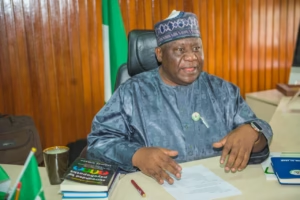
Sir, as a reforming agency, what are the measurable impacts that the Bureau has put so far on your target institutions?
Arabi : BPSR, as a background, was set up in 2004. We are saddled with the responsibility of initiating reforms, driving reforms, implementing reforms, informing reforms, doing monitoring and evaluation, and public service reforms. While we have the sole responsibility of initiating, others have the privilege to initiate but they must report back to us for the purpose of monitoring and evaluation.
In 2004, when we were created, the leadership thought it wise to produce what we call the National Strategy on Public Service Reforms. That strategy is the working and coordinating mechanism for all the work that we have done over the years. It’s our strategy, it’s our plan, it’s our tracker, it’s our monitoring and evaluation tool for all the reforms that have taken place in Nigeria from 2004 to date.
We have focused over the years on strengthening institutions of government, making them functional and effective. We have set up benchmarks and standards expected of all ministries, departments and agencies of government. And one of the things that we have done is to develop what we call a scorecard for ranking of websites of ministries, departments and agencies of government.
That is a program that has been introduced by us, working with other ministries, departments and agencies of government to get all websites of ministries, departments and agencies of government at the same level, with the same structure, but different content, with the same color, but different institutional colors to reflect what we are. Behind that, we say all ministries, departments and agencies of government should have functional websites, functional telephone lines, then interactive portals for citizens to engage with their customers, for citizens to engage with themselves, for citizens to engage with service providers in MDAs. We have worked effectively to make sure that there is transparency, accountability and improvement in quality of public service delivered by ministries, departments and agencies of government.
Now, when you look at transparency and accountability, I will come to discuss further what we have done around public financial management reforms. We have developed IPPS, integrated financial information management system, the government-integrated financial information management system. Now, the first one, IPPS, is meant to serve as the record controller of all human resource capital that we have in MDAs.
We have used that to fight ghost-worker syndrome within the public service. We have digitalized our records, so those days have gone when as a government worker, you can change your date of first appointment, date of birth, and remake your records.
Now, you can no longer do that. If you have to do it, you pass through a lot of hurdles. Unless you have something genuine, you cannot do that, and we no longer have ghost-workers in federal public service.
Along that line, too, we have worked with anti-corruption agencies and civil society to produce what we call Transparency and Integrity Index, T-I-I-N, where we check the performance of MDAs, and this is again linked to transparency. We expect MDAs to provide information on their procurements, on recruitments, every data that they need to provide, generate, must be on their website. We are working very hard on that.
All around that, the spirit is to improve transparency and accountability. We are members of the Standing Committee on the United Nations Commitment, where Nigeria has committed itself to transparency, accountability, and fighting corruption on camp. Nigeria will have what we call TUGA, a compendium of ministries, departments, and agencies of government fighting corruption and improving accountability within the public service.
We have run quite a number of capacity development programs on freedom of information. You know Nigeria has committed itself to OGP. One of the sub-legs of OGP is freedom of information.
That’s what we are doing on score card. We say every MDA must have an interactive portal for freedom of information on their website, so that citizens can ask questions, can interact, can get feedback immediately from ministries, departments, and agencies of government. We have also developed a framework of engagement between citizens and government, between government and citizens.
That is a platform that we have created, backed by that document, to ensure that citizens know the questions they are asking, and we know the responses we are supposed to be giving. Now that is the feedback mechanism that we have all initiated to improve the performance of ministries, departments, and institutions of government. Now what is our target?
Our target area is the entire federal public service. But going with time, when we realized that everybody on the payroll of federal government of Nigeria were just about 2.9 to 3 million. The population of Nigeria is about 240 to 260 million.
So more than 90 percent of Nigerians are in states and local governments. So we are working very hard to cascade these reform initiatives at the federal, to the states, and local governments.
Q: Now part of the question is measurable impacts.Can you narrow it down to maybe level of compliance on the part of the agencies that have initiated the reforms? What is the compliance level?
Arabi : The compliance level is almost 99.9 percent. Now if you look at public financial management, our target in 2007 was to digitalize public financial management 100 percent. As I’m talking to you today, no Nigerian federal public service agency or ministry uses pen, paper, or biro to make payments for services, for contracts by any citizen, by any company.
So that has been digitalized 100 percent. The impact of that is we have crawled into the space of technology just as other countries in the world have done. We have opened the space of managing resources of government because people now have the space to know how much has been released, how much has been utilized, who are the beneficiaries of this.
Accountability and transparency is the watchword, and I think we have done a lot around that. When we started the scorecard on ranking of websites of MDAs, we started with 20 MDAs. Today we are covering almost 500 MDAs.
When we started, more than 80 percent of our MDAs had no websites, or the websites were not active. Today 90 percent of our MDAs have functional websites, though they are not where they are, but we think we have done well in that reagards.
Now going beyond that, with the Treasury Single Account that was initiated by BPSR, the president can now sit down and say, as at this time, two minutes or ten minutes after one, how much has gone into the national treasury, and he’ll be able to know who are the beneficiaries of those resources, if they have been allocated by the Minister of Finance through the office of Accountant General of the Federation. The budget reforms and the openness and transparency that we’ve done, we can see that the process of developing a budget, civil society are part of it.
Even the process of determining what goes to what MDA, what needs to be done, civil society are part of the process and they are part of the trackers. We have set up civil society advocacy and citizens engagement groups, especially in Abuja, where we work a lot with them to educate them on what is their right, what is our responsibility, and that is why we are now looking at citizens as our customers, not just citizens. So we are looking forward in 2026 to do what we call a national citizens experience conference in Abuja, somewhere around June, where we further deepen this process.
Secondly, the Transparency Index that we have developed. Now people within the service understand that they cannot hide their procurement data, procurement details, records, all this must be provided on their website, because it is the right of the citizen to access this information on their website. So we have succeeded in digitalizing our process, we have succeeded in using technology to improve transparency and accountability within the public service, and etc
Q: Now, you cannot say yes it’s Uhuru yet. You have a mission, you have a vision, what are those things that you think you are yet to accomplish
Arabi : Well, if you ask me now, looking at our vision and mission statement, we say we want to make sure that through the work that we are doing, ministries, departments, and agencies of government are functional, they are efficient, and they are effective. If you look at the position of ministries, departments, and agencies of government, and the federal public service, before 2004, and today, I’m convinced and happy to announce that we have improved transparency, we have improved accountability, we have improved level of engagement, we have given citizens the right to assess us, engage with us, play a role in decision-taking. The national development plan just ended in 2025 December.
From the process of incubation, documentation, actualization, implementation, everywhere we have citizens as part of that. So, looking at our mandate, our vision, I think we have done wonderfully well. If you ask me to score, BPSR and the federal government, I’ll say we are over 90%.
We cannot say we are there yet, because the only thing constant in life is change. When we did the pension reforms, our target was one, to take that burden out of government. Secondly, to remove that burden of retirees coming to head of service complex to look for their money, some say two, three months, some end up losing their lives in that process.
We living witness to what was happening. We see the military pension office, where they took over the entire space. Today, those things are not there.
But reforms have DNAs, just the way human beings have, and they are changing over time. Now, initially, we have addressed that problem. Now, other problems have come up, inability of pension fund administrators to release payment in good time, problems with records, etc.
So, if you ask me, I will assess our performance 100%, but we need to do more. Changes are coming, disruptions are coming. One of the closest disruptions we’ve seen is COVID.
COVID came to say, the way you are working, you need to change. Apart from COVID now, we have AI, we have Internet of Things, we have blockchain technology. I’m happy to say we have an e-government master plan.
We have national policies for adoption of use of artificial intelligence and blockchain technology within the federal public service. We have institutions of government that have already adopted the use of AI in delivering public service. So, based on these parameters, I think we have done well.
Q: It looks as if the Bureau is doing excellently well, no hinderances, no obstacles. But I would assume that there will be some challenges the Bureau is battling with, and what are these challenges, and how do you intend to overcome the challenges?
Arabi: One of the challenges we are facing is the refusal of state governors to key into the directives of the President through us, for all of them to establish their own bureaus of public service reforms, and by extension, we cascade the reforms at the federal level to the states and local governments. This will take me to this point where I will commend Lagos State Government, who have created what we call the Down Commission, saddled with the responsibility of driving public service reforms over the years, and through them, we are now reaching all the states in the southwest region, and we are glad to say that after Lagos, we have Ogun State, they have also established their own Bureau of Public Service Reforms, and they are basically doing what we have done at the federal level. We have gone to Gombe State, they have created their own Bureau of Public Service Reforms, and they are basically replicating all what we have done at the federal level. We have gone to Kaduna State, and they have also reflected, adopted what we have done at the federal level.
Other states, they have not created their Bureau of Public Service Reforms, but we are seeing them taking, after federal, digitalizing their payroll, creating Bureau for Public Procurement at the state level.
Q: How many states so far have complied?
Well, only four states have created Bureaus of Public Service Reforms. By the use of public financial management reforms, basically all the states have keyed into that. So, we are encouraging them to get closer, to respond to us, and we will guide them on how they will do that, spend a little or no resources.
Why was BPSR created? To have an engine room, to have a center of data, a repository of information. I am glad to tell you that before the end of June 2026, BPSR is going to have a repository of all the work that we have done from 2004 to 2027 on our website, where people can access.
Now, if governments are not adopting this, we may have a reflection of what we have done at the federal level. Between the creation of Nigeria, or from colonial days to today, we have had about 15 public service reforms at the federal level. But the one from 2004, or 1999 to date, I think is the most central.
That is why we are here, and anybody that knocks on our door, we will tell him, these are the things that have happened over the years. And having an institution, or having institutions of government driving, managing, owning this process, I think is beneficial to the states, because we have seen the benefits in Lagos, in Ogun,in Gombe in Kaduna, and in all the states.
Q: How would you describe the Bureau’s working relationship with agencies,state governments, local governments, and all of that?
Arabi : At the federal level, it has been fantastic. We have two overseeing authorities, the National Council of Reforms, that is chaired by the President and Commander-in-Chief. And you can see that this makes our job easy, because since the President came, His Excellency Bola Ahmed Tinubu, who has been discussing reforms, reforms, reforms.
So, he has keyed in, and the Renewed Hope Agenda has keyed into the reform initiatives that we have been driving over the years. And I want to commend all the Presidents that have come in from His Excellency, President Olusegun Obasanjo, all what you have started. Nobody has come to say, why are you doing this?
But all what they’ve been doing is commending us and building on what we are doing. The next committee we have is the Standing Committee on Reforms, with the Head of Civil Service of the Federation, and Secretary to the Government of the Federation as Chairman. And we have Permanent Secretaries and Director Generals as members of this Committee.
So, this makes our relationship simple and easy, because they own the process, they own these initiatives. And wherever we go, we knock their doors, they open our doors. Our only problem is some of them feel we’re getting them out of their comfort zones.
Now, for changes to happen, we must get out of our comfort zones. Accountants didn’t like the idea of using AI to analyze balance sheets, but that is what the world is turning into. But that is not saying that accountants are losing relevance or losing their jobs.
It is not there for us to learn and understand how we use machines and human beings to provide results. Another challenge that we’re facing beyond relationship is funding. Funding has not been the way we wanted.
We’re appreciative of what governments have done, but we want more, so that we’ll be able to, I guess, like Oliver Twist, to whom much is given, much is expected, and a lot is expected out of us. But where resources are not coming, we’ll not be able to perform at our ultimate level.
Q: Apparently, Gombe is one of the beneficiary of the Bureau’s reform initiatives. Can you speak specifically on the sectoral benefits that Gombe has gotten.
Arabi : We want to celebrate Gombe. With due apologies to those that may say it’s my state. But even if it is my state, the Governor accepted us, received us, and during our first visit, when we presented an agenda for him on driving public service reforms in the state based on what we have done as a federal, there and then he gave an approval for creation of Gombe State Bureau of Public Service Reforms.
So, an institution was created to drive and implement these reforms. And he owns the institution, he owns the process, and he has been part of it. Immediately after that, we saw them implementing what we are doing at the federal level.
The first thing that he looked at was to address this issue of staff reluctance to come to work. So, by the time he eventually came on board, you clock in, you clock out. It is only fair that the revenues the government is generating is used to pay our salaries and where people are paid salaries and they don’t come to work is not right.
The second one was digitalization of the Gombe State Internal Revenue Office. It has been digitalized. A team is there that is basically doing what we are doing at the federal level.
We can see the growth in level of revenue generated in Gombe State by the agency. In the last four years, it has almost tripled. I don’t have the figures, so I cannot quote the figures.
Gombe State has created and established a procurement agency, similar to what we have done at the federal level. They are almost into pension commission, similar to what we have done at the federal level. They have adopted the use of technology in implementing public service or services in all ministries, departments, and agencies of government.
They have developed a Gombe State Development Plan to drive and guide their activities, just as we have the National Statute of Public Service Reforms at the federal and we have National Development Plan, Gombe State haa done same.That is the first state that has done that in Nigeria. The reforms that they have done has opened the state to investment, has opened the state to a lot of interventions, coming from World Bank, strategic partnerships have been established.
A lot of businesses, development partners are getting to the state to work with the government to drive some of these initiatives.
Q : On a final note, sir, we cannot but ask you, as an indigene of the state and a highly placed technocrat, not to comment on institutional reforms and socio-economic development of the state under Governor Muhammadu Inuwa Yahaya.
Arabi : As I said before this time, he welcomed us, listened to us, and copied what we have done at the federal and adopted that in the state.
Anybody that visits Gombe State, that visited Gombe 10 years ago and is visiting today, will have seen the magnitude of work that has been done in terms of infrastructural development, development of education, institutions of learning, primary, secondary school, and universities.
Apart from the Gombe State University, we have Lincoln University that is coming on board and other institutions of government.
So, he has done a lot in terms of human capital development.
He has done a lot in terms of education by renovating virtually all secondary schools, primary schools in the state. Of course, if you don’t have a scale, an upscale public service, you cannot deliver. If you have a population that is not going to school, that is not educated, you are sitting on a time bomb.
We have seen a lot of development in the health sector, a lot of reforms on board. The most recent one is the special salary that he is paying to medical personnel. We are hoping that most of the professors in the University of Ibadan Teaching Hospital will relocate from Ibadan and do their job in Gombe.
He is doing quite a lot of work around security, especially using technology. I want to commend him for agreeing to work with us, the federal government, GALAXY, and NITDA to provide connectivity for ministries, departments, and agencies of government, and also for local governments. He has accepted and hosted the Bureau of Public Service Reforms in the state.
The recent one was the Directors of Reforms, Nationwide Directors of Reforms training workshop that we did in Gombe. He was not there in person, but he was represented and the state government worked with us. Beyond that, we had officials of local governments that were directed to join the federal government team, and we are trying to hold the state officials and the local governments to see that we implement what we are doing at the state level.
I think he has done wonderfully well. He has changed the fortunes of the state. He has set a record that will take a very long time for whoever is coming to bypass it, but I want to say that this is not the achievement of His Excellency Inuwa alone.
He has a team, a capable team that has been working with him, and he has opened his doors for development partners, for federal government agencies to work with him. It is a collective effort by everybody concerned to support him to make sure that he succeeds.