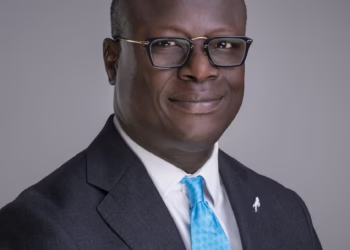



By Professor Tayo Popoola
There is a nickname that has followed Michael Adeniyi Agbolade Ishola Adenuga Jr. for decades: the Bull. It is more than a colourful tag attached to one of Nigeria’s most successful businessmen. It has become a fitting metaphor for a career marked by persistence, audacity and an unusual willingness to enter difficult territory.


Perhaps the best way to understand the Bull is to begin with a setback.
In 1999, Adenuga’s company was among those awarded a GSM licence during Nigeria’s first telecommunications licensing process. The licence was subsequently revoked. The setback did not end his interest in telecommunications. He returned to the race, bidding for the Second National Operator licence in 2002 through Globacom. This time, he won. Globacom received the licence and began rolling out services the following year.
That is the first lesson in the story of the Bull: a closed door is not necessarily the end of the road.
On August 29, 2003, Globacom launched its mobile service into a Nigerian telecommunications market that was already being shaped by MTN and Econet. The incumbents had roughly a two-year head start, established infrastructure and experience in the business. Glo was the latecomer.
But Glo arrived late without arriving timidly.
Its most memorable early challenge to the established order was per-second billing. At a time when consumers were largely paying for mobile calls by the minute, Glo introduced billing by the second from its launch. It also pushed down the cost of acquiring a GSM line. The result was a change in the competitive conversation, as rival operators moved to introduce per-second billing options of their own.
The significance of that moment is easy to underestimate today. A new company had entered a market controlled by established players and, rather than simply imitating them, questioned one of the market’s assumptions. Glo did not have the advantage of being first. It found another advantage: the freedom to challenge what everyone else had accepted.
That was the first charge of the Bull.
And it was not an isolated one; Adenuga’s entrepreneurial story had already been shaped by ventures in sectors where persistence mattered. From his early business activities to oil and gas, banking and eventually telecommunications, his career has followed a recurring pattern: identify an opportunity, accept the difficulty and commit to the long game.
That pattern helps explain why Glo’s story cannot be reduced to a clever tariff. Two industries, two long waits, two calculated charges. If per-second billing was the Bull’s charge above ground, Glo-1 was the charge beneath it.
Globacom’s investment in the Glo-1 submarine fibre-optic cable represented a much bigger ambition than competing for mobile subscribers. The approximately 9,800-kilometre cable connects Lagos with international landing points including Accra and Bude in the United Kingdom. It entered service in 2010 and gave Globacom direct ownership of an international telecommunications infrastructure asset.
The symbolism is difficult to miss because Glo had first challenged the price of communication. Then it invested in the infrastructure behind communication.
That distinction matters. A company can compete by offering cheaper calls, attractive data packages or promotions. Building international connectivity infrastructure requires thinking beyond the immediate customer and investing in the system on which future communication depends. Globacom’s own description of its network highlights Glo-1 alongside its extensive domestic fibre and microwave infrastructure.
The Bull, then, was not simply charging at the market. He was building beneath it.
Yet there is an intriguing contradiction at the centre of Adenuga’s public image. The scale of his business ambitions has often been matched by the quietness of his personal profile. He has generally avoided the relentless public exposure that accompanies many prominent business figures. His companies, however, have often spoken loudly.
Glo certainly has from the beginning, the brand understood that telecommunications was about more than technology. It was about people, culture and the things people use connectivity to experience. Its long association with football and entertainment helped take the brand beyond the SIM card and into Nigeria’s popular culture. Globacom’s sponsorship of the CAF African Player of the Year Awards, which began in 2005, became one of the company’s most prominent international sporting associations.
That strategy revealed another dimension of the Glo story. People do not connect merely because they want a network connection. They connect to family, business, entertainment, sport, information and opportunity. In that sense, Glo’s cultural presence reflected the broader purpose of telecommunications: connection is ultimately human.
Twenty-three years in such a demanding industry is also not a record of uninterrupted triumph. Telecommunications has changed dramatically since 2003, bringing smartphones, mobile internet, streaming, digital commerce and increasingly demanding consumers. Operators have had to contend with competition, infrastructure challenges, regulation and the relentless pace of technological change.
Longevity, therefore, should not be confused with perfection. It should be recognised as resilience.
And resilience may be the most appropriate word with which to return to the Bull.
At 23, Globacom represents more than the survival of a Nigerian telecommunications company. It represents the consequences of entering an established industry and refusing to be defined solely by the advantages of the incumbents. Glo came after the pioneers, but it found ways to make the pioneers respond. It challenged pricing, invested in infrastructure and built a brand that reached beyond the technical business of telecommunications.
That is where Adenuga’s personal story and Glo’s corporate story meet.
The achievement is not simply that a Nigerian businessman became wealthy. Nor is it merely that a company has lasted 23 years. The more interesting achievement is the demonstration of what Nigerian enterprise can attempt when it is willing to think beyond the obvious limits of the moment.
The Bull’s legacy, therefore, should not be reduced to aggression or risk-taking. The more useful metaphor is forward movement.
The Bull charges because standing still is not an option. When one door closed in telecommunications, Adenuga returned. When Glo entered the market late, it challenged the rules. When competition intensified, the company invested in infrastructure. When telecommunications became increasingly intertwined with culture, Glo expanded its presence beyond the phone.
Three decades have not yet passed, but 23 years have already left their mark.
So this is an ode not merely to a billionaire, and not merely to a telecommunications company. It is an ode to audacity, persistence and the confidence to challenge an established order.
Twenty-three years after Glo entered Nigeria’s telecommunications arena, the market has changed, the technology has changed and the consumer has changed.
But the tracks of the Bull remain.
And perhaps that is the enduring lesson of Glo at 23: sometimes the rules of the market are not walls. Sometimes, they are simply fences waiting for someone bold enough to charge through them.
**Popoola, a Professor in the hevDepartment of Communicationwrites from University of Lagos, Akoka, Lagos